So you've decided you'd like a beret, you've arrived at South Pacific Berets and now you're confronted with a rather unexpected problem: there are an awful lot of berets. Who would have thought?
Choosing a beret is one of the more personal choices you can make when it comes to headwear. On paper, a beret is a remarkably simple thing: essentially a circular piece of felted or knitted material with a cabillou or txortena—the little "wick" on top. Yet two berets that look broadly similar can feel, fit and behave completely differently.
There is the size of the beret, the size of your head, the diameter or plateau, the amount of flight or overhang, the weight and density of the wool, the choice of merino, cotton or other fibres, and whether the beret is lined with satin, cotton or linen - or left unlined.
Then there is the more important question: what do you actually want the beret to do? Do you live somewhere warm or cold? Do you need protection from rain or sun? Are you looking for a practical everyday hat that can be stuffed into a pocket, or something with a little more elegance and presence? Are you a bricklayer looking for something that works, an outdoor enthusiast wanting weather protection, or an executive who wants to make a statement? There is a lot to consider.
The good news is that there is no single "correct" beret. The best beret is the one that suits your head, your climate, your use and your personal taste.
Finding Your Way Around South Pacific Berets
Our berets are organized primarily by country and manufacturer. There is some logic to this—an Italian beret can be quite different from a French or Spanish one—but it also gives us a manageable way of organizing a rather large collection.
Don't be afraid to explore. Compare the diameters, sizes, materials, colours, weights and prices, and look at the photographs. A beret that looks modest on the screen can be surprisingly substantial when worn, while a small-diameter beret can be considerably more discreet. If you're new to berets, the following guide should help narrow things down.
Which Beret Should I Choose?
At the top end are the artisan-made berets from Boneteria Auloronesa/BarNaBé, the Spanish Boinas Elósegui Super Lujo, and the Japanese-made Flamingo berets. These are particularly good choices if you appreciate fine materials, careful manufacture and the distinctive character of a genuinely well-made beret.
For a practical everyday beret, look at our own South Pacific Berets, the Italian Bascos Roma, Argentinean boinas by Arandú, and some of the vintage Etchea, Chirola and Rafale models. The Czech Classic is another good choice. These are the sort of berets that can simply become part of your daily wardrobe rather than something reserved for special occasions.
If you want a beret that sits relatively close to the head and doesn't have a great deal of overhang, look at the smaller-diameter models. The Orthez 9P by BarNaBé, Czech-made Radiovka, Italian Roma, and New Zealand Qui-Oui are all good examples.
These can be particularly comfortable around the house or for anyone who prefers a less conspicuous silhouette.
If subtlety isn't your principal concern, there are considerably larger berets.
The Spanish Txapeldun, the Grand Foulards Alpin by BarNaBé, and the larger Flamingo Basques offer considerably more material and a much more pronounced silhouette.
A large beret can look spectacular. It can also attract attention - not necessarily a disadvantage.
Beret Diameter and Flight
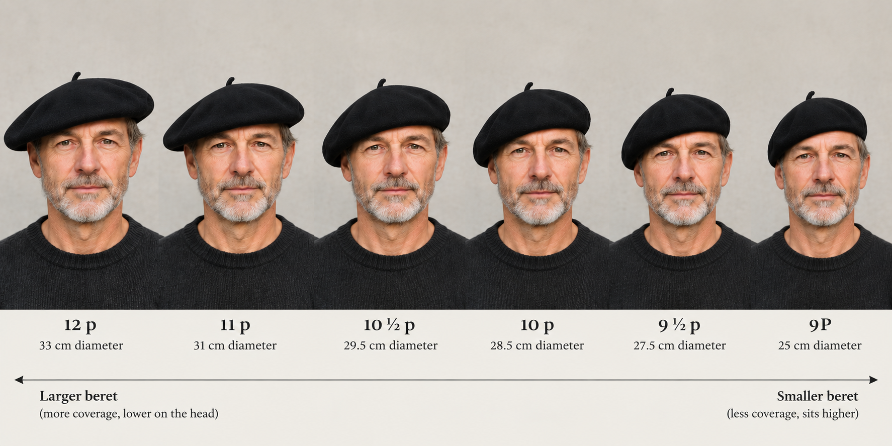
One of the most important things to understand when choosing a beret is diameter.
The flight, sometimes called the plateau, is the surplus material extending beyond the head. It is what allows a beret to be shaped and worn tilted to one side, towards the back, or in other styles.
In general, the larger the diameter, the more material there is to work with.
These berets sit relatively close to the head, with little overhang. Examples include the French Orthez 9P, Italian Roma, and Czech Radiovka.
They are a good choice if you prefer a compact, discreet beret.
This is where you find many traditional everyday Basque berets. Examples include BarNaBé/Auloronesa models and the Boinas Elósegui Super Lujo in 11P/31 cm.
There is enough material to shape the beret in different ways without it becoming excessively large.
Larger berets provide considerably more flight and allow a more pronounced Basque or French-style silhouette. These are particularly worth considering if you like a generous amount of material around the head or want greater protection from sun and weather - the typical outdoors beret.
This is beret territory for the committed. The large Alpin, Txapela and Plato Grande models can reach around 37 cm in diameter. They provide a great deal of material to work with and excellent protection from sun and weather. They can also be, well, large.
If you're not accustomed to a grand beret, wearing a 37 cm model for the first time may require a little courage - particularly if your surroundings are not accustomed to people wearing grand berets. But, that is also rather the point.
What Size Beret Should I Buy?
Diameter and head size are two different measurements. Your head size determines whether the beret fits around your head. The diameter determines how much material there is beyond your head and therefore how much flight or overhang you have.
A larger-diameter beret does not mean you need a larger head size. When choosing your size, measure around your head where you intend to wear the beret, normally approximately 1 cm above your eyebrows and ears. Use that measurement to select the appropriate size offered for the particular beret. Different manufacturers can size their berets slightly differently, so always check the individual product's sizing information rather than assuming that the same nominal size will fit identically across every manufacturer.
If you're unsure, contact us. After more than 15 years of specializing in berets, we've had to think about this rather more than most people.
What Material Should I Choose?
Most of our traditional wool berets are made from fine wool, particularly merino wool. Merino wool provides excellent insulation while remaining breathable, and wool naturally absorbs moisture and odours. It is also exceptionally well suited to the dense felting process used to make traditional berets. The resulting felt is naturally water-resistant. In general, a denser and heavier wool beret will resist rain for longer than a very light one.
Several of the French BarNaBé/Auloronesa berets have particularly high water resistance as a result of their manufacturing process, while some higher-end Spanish berets receive additional waterproofing treatments. A wool beret is therefore a particularly good choice if you want one beret that can handle changing weather and be worn throughout much of the year.
Cotton
Cotton berets are generally lighter than their wool equivalents and are particularly comfortable in warmer weather. They breathe well and can be an excellent summer alternative, although some customers become sufficiently attached to cotton that they wear their cotton berets throughout the year. Our cotton berets are knitted from a single thread in much the same basic construction as a wool beret, and finished with the traditional txortena on top.
Other materials
You'll also find berets made from linen, hemp and other fibres. These can have quite different characteristics from traditional wool and are worth considering if you're looking for something particularly lightweight, breathable or unusual.
Lining
The lining is partly a matter of taste, but it also affects how a beret feels and behaves. A lined beret generally feels smoother against the head and can help the beret retain its shape. Satin, cotton and linen are among the materials used for linings. An unlined beret has a more direct contact with the wool and can feel lighter and more breathable. Some traditionalists particularly like the simplicity of an unlined beret.
There is also a little piece of beret folklore attached to linings. French farmers and labourers were traditionally known to keep paper money between the beret and its lining. A few centimeters of the stitching would be opened to make a convenient little hiding place.
Which Beret Is Best for Warm Weather?
For hot or humid climates, look first at:- lightweight cotton berets
- lightweight wool berets or the top quality merino berets
- unlined berets
- smaller-diameter models
A larger, heavy wool beret provides excellent protection in cold and wet weather but may be more than you want in midsummer. That said, climate isn't everything. Some people happily wear substantial wool berets throughout the year, while others prefer cotton as soon as the temperature rises.
Which Beret Is Best for Rain?
A densely felted wool beret provides excellent protection from rain. For particularly wet conditions, look at the heavier and denser wool berets and models specifically treated for water resistance. A larger beret also provides more protection from sun and rain simply because there is more material extending beyond the head. The traditional Basque beret was, after all, not designed merely to look good.
Which Beret Is Best for Everyday Wear?
If you're buying your first beret, don't necessarily start with the largest or most exotic model.
A medium-diameter wool beret around 28–31 cm is a good starting point for many people. It provides enough material to shape and wear in different ways without becoming overwhelming.
If you want something particularly refined, look at the higher-end Spanish, French and Japanese makers.
And if you already know that you want a large, dramatic beret, there is no reason to work your way gradually towards it. Go straight to the Txapeldun.
A Final Word on Choosing a Beret
There is no universally "best" beret.
A 25 cm Italian Roma may be perfect for one person and hopelessly small for another. A 37 cm Txapeldun may be ridiculous on one head and magnificent on another.
The right beret depends on your head, your climate, your intended use and, ultimately, what you like looking at in the mirror. Our advice is to explore the range, compare the specifications and photographs, and don't be afraid to try something different. And if you're still unsure, ask us.
We have been specializing in berets since 2009 and have spent a disproportionate amount of time thinking about such things. We'll be happy to help.
Guarantees, Exchanges & Returns
All berets we sell are fully guaranteed against material or manufacturing faults.
Because berets are worn directly on the head, we cannot exchange or refund a beret for reasons of fit, size or preference once it has been worn or tried on. Please check the sizing information carefully before trying your beret on, and contact us if you are uncertain about which size or model to choose.
Size
To determine your head size, measure around your head where the beret would sit, then convert to a hat size using the following chart:
| Inches | 21 1/2 | 21 7/8 | 22 1/4 | 22 5/8 | 23 | 23 3/8 | 23 3/4 | 24 | 24 1/2 | 25 | 25 1/2 |
| Hat Sizes | 6 3/4 | 6 7/8 | 7 | 7 1/8 | 7 1/4 | 7 3/8 | 7 1/2 | 7 5/8 | 7 3/4 | 7 7/8 | 8 |
Hat Sizes | SM | SM | MED | MED | LG | LG | XL | XL | 2XL | 2XL | 3XL |
| Metric | 54 | 55 | 56 | 57 | 58 | 59 | 60 | 61 | 62 | 63 | 64 |